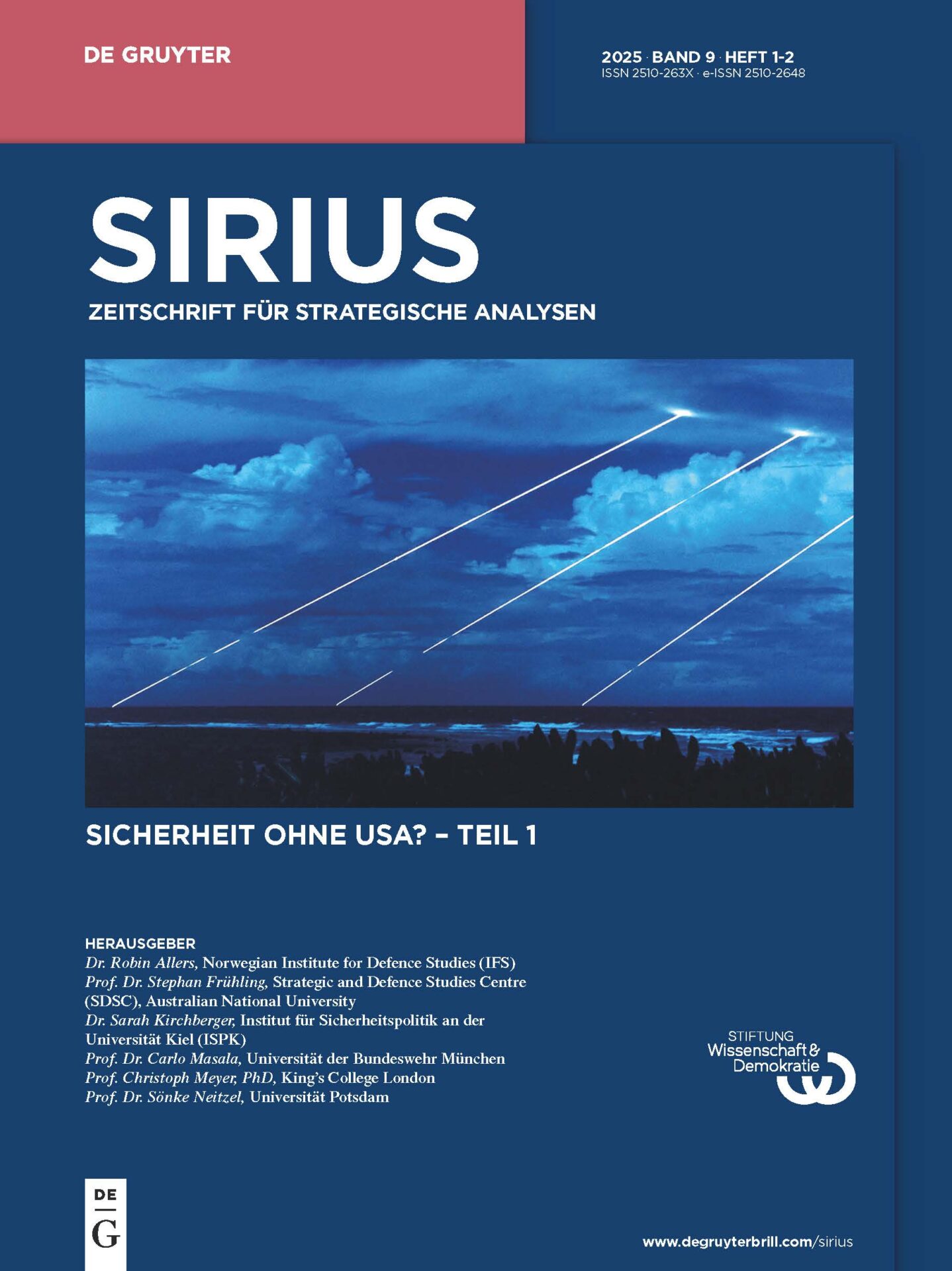
The first double issue 2025 focuses on nuclear issues, including articles on extended nuclear deterrence and the debate surrounding a possible „Eurodeterrent“:
- Martin Bader, Maximilian Dambacher and Marcus M. Keupp argue in their article „If Europe wants to defend itself, it must hurry“, that Europe must develop its own military capabilities in the face of uncertain US support in order to credibly deter Russia. They provide an inventory of the tasks assigned to the individual countries in terms of European burden sharing, as well as answers to the question of their defence capabilities.
- In his essay „Extended deterrence and strategic stability in Europe: Germany and its partners need a plan for the future“ warns Frank Hagemann, that the nuclear imbalance in the North Atlantic region is having a destabilising effect and that there is a growing risk of European security being decoupled from the United States.
- Henrik Stålhane Hiim discusses in his essay „Keep All the Flawed Options on the Table: Europe's Nuclear Future” the key strategic, political and technical challenges facing proposals for „Eurodeterrence“ at a time when Europe's confidence in US nuclear deterrence is waning.
- In his essay “Incurable security through nuclear sharing in asymmetric NATO“ looks Christian Tuschhoff on indivisible security as a core principle of NATO. He argues that this is based on agreements and cooperation practices of the member states.
- Andreas Lutsch categorises in his article „Euro-American security cooperation, long-range medium-range weapons and nuclear deterrence in historical perspective“ The deployment of long-range conventional stand-off weapons by the USA in Germany, France, Italy and Poland, which was decided in July 2024, is historic. It shows how strongly earlier forerunners of similar projects characterise today's debate on European armaments cooperation and deterrence capability.
- Michael Rühle reminds in his article „80 years after Hiroshima: The evolution of nuclear deterrence and the concepts for overcoming it“ The fact that the logic of nuclear deterrence has always had the upper hand in the constant competition with the logic of disarmament.
The issue also contains an analysis of the current military situation in the Middle East by Sebastian Hamann, an essay on reform perspectives of the Federal Security Council by Thomas Horlohe, an interview with Karl Kaiser on the strategic capability of the Federal Republic of Germany and two Book reviews.
As usual, the entire current issue is available online under the Open Access licence via the publisher De Gruyter Brill HERE freely available.