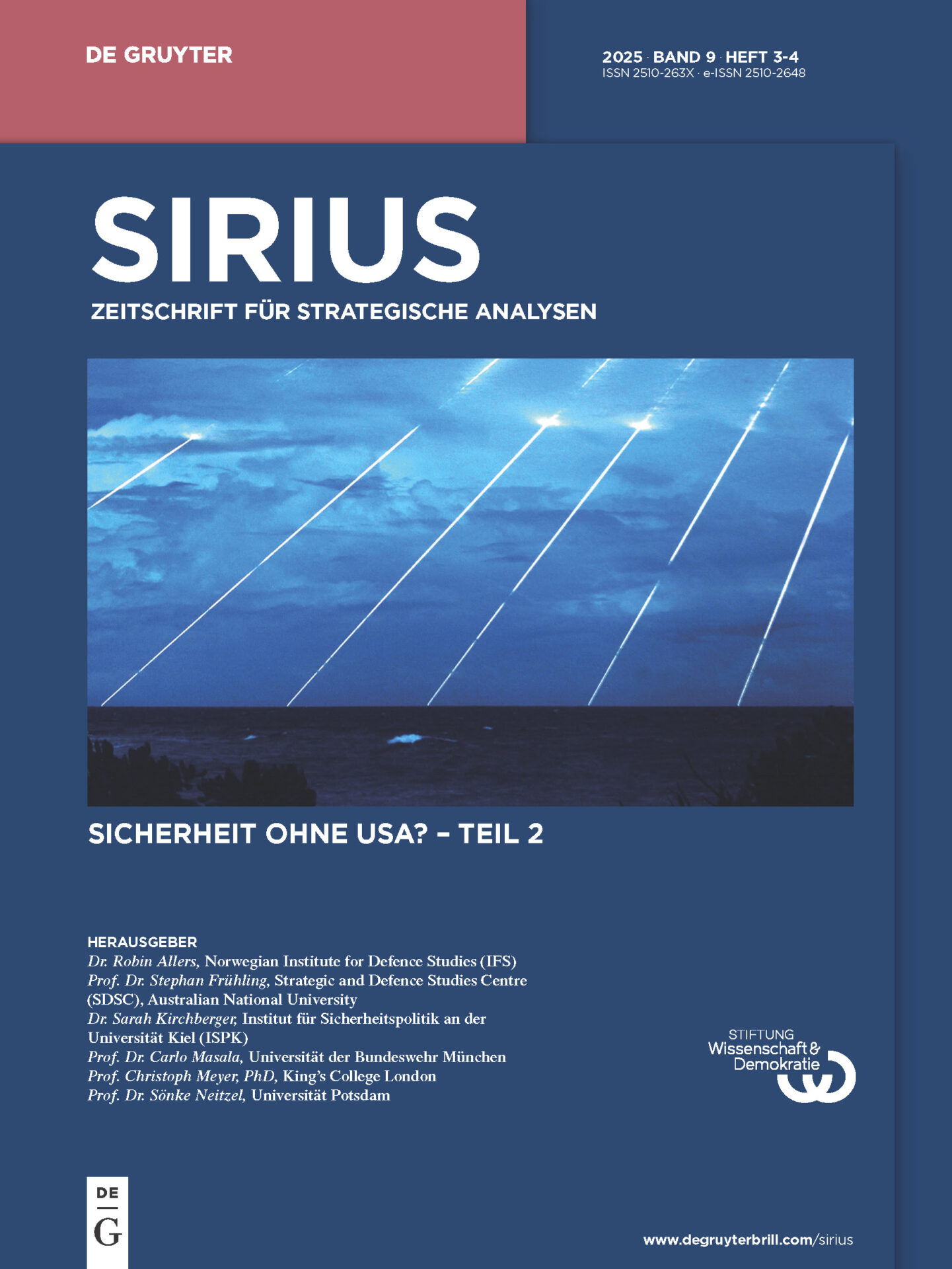
The second double issue, 2025, focuses on the maritime dimension of European dependence on the United States; at the same time, the perspective is broadened to include the Indo-Pacific. Nuclear issues also remain present in this issue, particularly with regard to the consequences of a possible change in US strategy in the region and its impact on Europe. The background to many of the articles is China's endeavour to weaken existing US alliances and establish itself as a regional hegemonic power. This endeavour is supported by a rapidly growing conventional and nuclear arsenal:
- Sebastian Bruns and Christian Jentzsch show in their essay „NATO and the USA as a naval power“, that no other military alliance is currently as strongly maritime in character as NATO. Based on the historical development of NATO as a collective naval power, they trace how the maritime dimension of the alliance has changed at a strategic level and what role the USA has played in this. Today, according to their findings, deterrence against the nuclear power Russia and collective defence are once again at the centre of the tasks.
- Sarah Kirchberger analyses in her essay „The Indo-Pacific deployments of European navies in 2024: review and evaluation“ the significant increase in European naval activity in the Indo-Pacific since 2024. It describes the objectives of the deployments and their joint potential to safeguard the „rules-based international order“.
- In „China's statecraft: co-operation and coercion - China's strategy to divide the US alliances in Asia-Pacific and Europe“ analysed Maximilian Ernst China's statecraft in the Indo-Pacific region, which is based on a mixture of cooperation and coercion. In view of the increasing interdependence with the Euro-Atlantic region, European states are also increasingly coming under the influence of these so-called „wedge strategies“.
- Wolfgang Rudischhauser illuminates in his essay „Between renouncing a first strike and rapidly expanding its nuclear arsenal: China's rearmament and how the West should respond“ China's rapid nuclear armament and questions whether this development is compatible with the country's proclaimed policy of renouncing first strikes. He shows the risks that China, as the third largest nuclear power, poses to regional and strategic stability and warns that a new arms race could be favoured by misperceptions and overreactions.
- In his article „South Korea's deterrence strategy“ argues Eric J. Ballbach, that a conventional deterrence strategy is of central importance for South Korea in view of the growing nuclear threat from North Korea and the uncertain US security guarantees.
- Mansoor Ahmed argues in his article ”Emerging Force Balances and Postures in South Asia: Trends and Trajectories”, that India's long-standing conventional superiority over Pakistan has been significantly weakened since the Ladakh crisis in 2020. Increased conventional deterrence by Pakistan is likely to further exacerbate India's „two-front dilemma“.
The issue also contains a brief analysis of Japan's dependence on the United States of Michito Tsuruoka, a comment from Beatrice Heuser on the security of Europe without the USA, a report by Joshua Lehmann, who takes a critical look back at the „Land Warfare Conference 2025“ and two Book reviews.
As usual, the entire current issue is available online under the Open Access licence via De Gruyter Brill Verlag HERE freely available.